
Virtual and AR Property Tours: The Future of Home Hunting in India's Tier 1 Cities
Addressofchoice 29 April 2026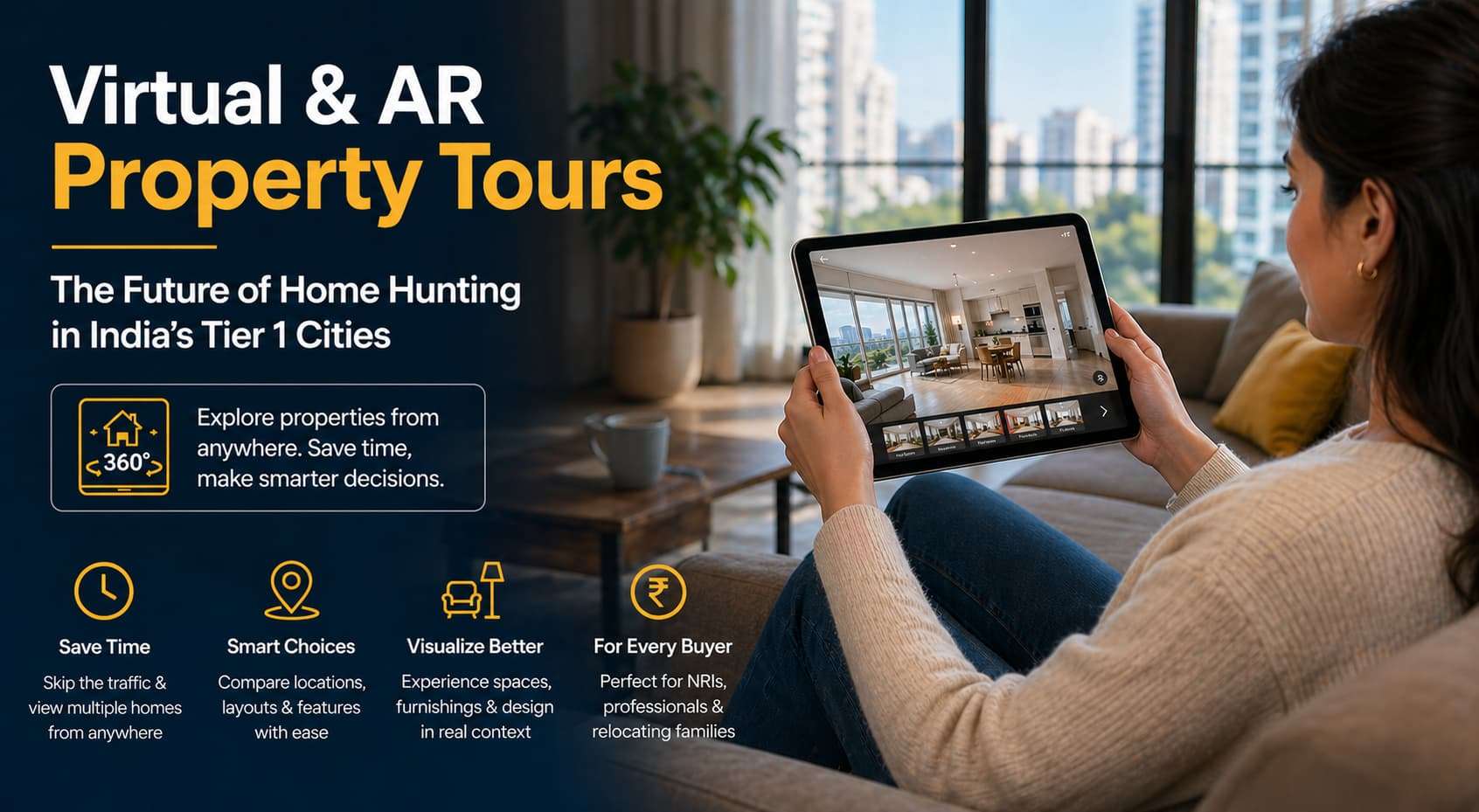
Picture this: It's Saturday morning in Mumbai. You've planned to view five properties—one in Andheri, two in Worli, one in Thane, and another back in Bandra. By conservative estimates, you're looking at eight hours of your weekend consumed by traffic alone. Add the actual viewings, and your entire day vanishes. Worse still, there's a strong possibility that none of these properties will meet your expectations, meaning you'll repeat this exhausting exercise next weekend.
For NRIs, the situation is even more challenging. Flying from Singapore or Dubai for a weekend of property viewings isn't just inconvenient—it's expensive and logistically complex. How many trips can you realistically make before finding the right home?
Young professionals in Bangalore face similar frustrations navigating the traffic between Whitefield and Electronic City. Families relocating from Delhi to Hyderabad struggle to evaluate neighbourhoods they've never visited. The traditional property viewing process, particularly in India's sprawling tier 1 cities, has become an exercise in endurance rather than excitement.
But technology is changing this narrative. Virtual and augmented reality property tours are transforming how buyers discover, evaluate, and ultimately purchase homes. Whilst this revolution is still unfolding in India, the shift towards smarter, more efficient property search has already begun—and platforms like AddressOfChoice are making it easier to navigate this transition.
Why Virtual Tours Matter in India's Tier 1 Cities
India's metropolitan areas present unique challenges that make virtual property tours not just convenient but increasingly essential. Each tier 1 city has its own geographic and logistical complexities that traditional property viewing struggles to accommodate.
The Geographic Reality
Mumbai's linear geography creates a particular nightmare for property hunters. A flat in Andheri West and another in Chembur might both be "in Mumbai," but they're separated by an hour and a half of traffic on a good day. The Western Line, Central Line, and Harbour Line might as well be different cities for the time it takes to traverse them. For buyers considering properties across the metropolitan region, viewing even a handful of options can consume weeks.
Delhi-NCR's sprawl makes Mumbai's challenges seem modest. The National Capital Region spans multiple cities—Gurugram, Noida, Faridabad, Ghaziabad—each with distinct characteristics and property markets. A professional working in Gurugram's Cyber Hub and someone employed in Noida's tech corridor have entirely different location priorities, yet both are technically in "Delhi-NCR." Travelling from Dwarka to Greater Noida for a single property viewing can take three hours each way.
Bangalore's traffic has become legendary, particularly during office hours. The city's multiple employment hubs—Whitefield, Electronic City, Outer Ring Road, Hebbal—mean that buyers often need to view properties across vast distances. What appears to be a 15-kilometre journey on the map can consume two hours during peak traffic.
Hyderabad's evolution from a traditional city to a technology hub has created distinct zones—the historic old city, the HITEC City corridor, Gachibowli's financial district, and emerging areas like Kokapet. Understanding these areas requires local knowledge that outsiders rarely possess.
Pune's east-west divide confuses even locals. Properties in Hinjewadi, Wakad, and Baner cater to IT professionals, whilst areas like Koregaon Park and Kalyani Nagar attract different demographics. For someone relocating to Pune, distinguishing between these micro-markets from afar is nearly impossible.
Chennai's OMR (Old Mahabalipuram Road) corridor has grown so rapidly that neighbourhood characteristics change every few kilometres. The distance between central Chennai and OMR tech parks creates similar viewing challenges to other metros, compounded by the city's coastal climate requiring specific property features.
The Target Audience Challenge
These geographic realities create distinct pain points for different buyer segments, each of whom would benefit tremendously from virtual touring capabilities.
- NRIs and expatriates face the most acute challenges. Flying to India for property viewings means coordinating leave, booking flights, and compressing what should be a deliberate decision-making process into a few frantic days. Many NRIs end up relying entirely on family members or agents, making one of life's biggest financial decisions without personally seeing the property. Others make multiple expensive trips, each time discovering that their shortlisted properties don't meet expectations.
- Young professionals in their late twenties and early thirties value their limited leisure time highly. After working long hours throughout the week, spending entire weekends stuck in traffic viewing unsuitable properties feels like a waste of precious personal time. This demographic is also the most digitally native—comfortable making significant decisions based on online information and virtual experiences.
- Families relocating between cities grapple with the uncertainty of moving to unfamiliar locations. A family moving from Chennai to Bangalore needs to understand not just individual properties but entire neighbourhoods—school quality, safety, community culture, and amenities. Traditionally, this meant either making risky decisions based on limited information or expensive exploratory trips before the actual move.
The Hidden Costs of Traditional Viewings
Beyond the obvious time consumption, traditional property viewing carries substantial hidden costs that often go unaccounted for.
- Time wastage in Indian metros is staggering. In Mumbai, viewing a single property can easily consume three to four hours when you factor in travel time. Multiply this by the 15-20 properties a typical buyer views before making a decision, and you're looking at 45-60 hours—more than a full working week—spent purely on logistics.
- Travel costs accumulate quickly. Petrol, parking fees, and wear on your vehicle mount up over weeks of property hunting. For those using cabs or auto-rickshaws, each viewing trip can cost several hundred rupees in transportation alone.
- Opportunity cost might be the most significant expense. Those weekends and weekday evenings could have been spent with family, pursuing hobbies, or simply resting. For professionals, taking time off work for property viewings means using precious leave days or rushing through viewings during lunch breaks.
- Decision fatigue sets in after viewing multiple similar-looking properties. By the tenth viewing, details blur together, making it harder to remember which property had the better kitchen or more natural light. This mental exhaustion often leads to poor decisions or unnecessary delays as buyers struggle to recall and compare options.
Understanding Virtual and AR Property Tours
The technology transforming property search globally comes in several distinct forms, each offering different capabilities and experiences. Understanding these variations helps buyers recognise what's available and what might be coming to India's property market.
Virtual Tours: Exploring Spaces Remotely
Virtual property tours create digital representations of physical spaces that users can navigate from any device with an internet connection. The most common implementation uses 360-degree photography to capture rooms from multiple angles, allowing viewers to look around as if standing in the space.
These tours typically feature interactive navigation—clickable arrows or hotspots that let viewers move between rooms, similar to walking through a property. Users can look up at ceilings, down at floors, and around at walls, gaining a comprehensive sense of room dimensions and layout.
More sophisticated virtual tours incorporate clickable information points. A viewer might click on a kitchen appliance to see specifications, or select a window to learn about the view or natural light exposure. Some implementations include measurement tools, allowing potential buyers to verify dimensions of specific areas.
The key advantage of virtual tours is accessibility. Unlike physical viewings that require scheduling and travel, virtual tours are available 24/7 from anywhere in the world. A buyer in London can explore a Mumbai property at 2 a.m. UK time without bothering anyone. Families can tour properties together remotely, with members in different cities all viewing simultaneously whilst on a video call.
Augmented Reality: Visualising Possibilities
Augmented reality takes a different approach by overlaying digital information onto the real world through smartphone or tablet screens. In property applications, AR typically allows users to visualise furniture placement, design changes, or renovations before they happen.
A buyer viewing an empty flat can use an AR app to see how their sofa would fit in the living room, whether their dining table would overwhelm the space, or how a home office setup might work in a bedroom. This capability is particularly valuable in Indian metros where space comes at a premium and every square foot must be optimised.
AR applications also enable design experimentation. Want to see how the flat would look with different wall colours? AR can show you instantly. Considering knocking down a wall to create an open kitchen? AR can visualise the result before you commit to expensive renovations.
Some advanced AR implementations allow measurement of spaces through the phone's camera. Point your device at a wall, and the app calculates its length. Measure ceiling height, doorway widths, or any dimension without a tape measure. This feature proves invaluable when assessing whether existing furniture will fit in a new home.
Virtual Reality: Full Immersion
Virtual reality represents the most immersive property viewing technology. Using VR headsets, potential buyers can "walk through" properties as if physically present. The 3D environment surrounds viewers completely, providing a genuine sense of being in the space.
VR tours offer spatial understanding that photographs and even 360-degree tours cannot match. Users develop an intuitive feel for room sizes, ceiling heights, and how spaces connect to each other. The technology can also simulate different times of day, showing how natural light changes or how the property feels in evening versus morning light.
The primary limitation of VR in the Indian market has been accessibility. VR headsets, whilst increasingly affordable, aren't yet ubiquitous in Indian homes. However, smartphone-based VR solutions using inexpensive headsets are making the technology more accessible, potentially accelerating adoption.
The Technology Foundation
All these virtual viewing technologies rely on several underlying technical capabilities that have only recently become sophisticated and affordable enough for widespread property market application.
High-resolution imaging forms the foundation. Modern cameras capture extraordinary detail, allowing zoom and close inspection of finishes, fixtures, and build quality. Cloud-based storage and delivery systems make these large image files accessible without requiring downloads or special software.
3D mapping and spatial awareness technologies—originally developed for gaming and autonomous vehicles—enable the creation of accurate digital property models. These systems can measure and replicate real-world spaces with centimetre-level precision.
Importantly for the Indian market, most modern virtual tour platforms are mobile-first, designed to work seamlessly on smartphones rather than requiring desktop computers. This approach recognises that many Indian users access the internet primarily through mobile devices.
The Current State: Virtual Tours in Indian Real Estate
Whilst virtual and AR property tours are transforming markets globally, adoption in India remains selective and uneven. Understanding who offers these technologies currently, and in what contexts, helps set realistic expectations about what's available today.
Who's Offering Virtual Tours
Premium developers have led adoption, particularly for luxury projects priced above ?5 crore. High-end builders in Mumbai, Bangalore, and Gurugram routinely offer virtual tours for under-construction projects, recognising that their target buyers—often NRIs or busy executives—value the convenience. These tours typically showcase sample flats and common amenities with professional-grade production values.
Major property portals have begun incorporating virtual tours for select listings, though coverage remains limited. These platforms face the challenge of retrofitting virtual tour capabilities across millions of existing listings whilst managing varying levels of seller cooperation and technological sophistication.
International real estate platforms entering the Indian market often bring virtual tour capabilities as standard features, raising expectations amongst Indian buyers who've experienced these technologies abroad.
Boutique agencies in metropolitan areas, particularly those serving expatriate communities or NRI buyers, have adopted virtual tours as a competitive differentiator. These agencies recognise that their international clientele expects digital-first property experiences.
Types of Virtual Experiences Currently Available
The virtual property viewing landscape in India encompasses several distinct implementation levels, each offering different capabilities and user experiences.
Basic 360-degree photo tours represent the most common implementation. These static tours allow rotation to view rooms from different angles but lack the sophisticated navigation of advanced platforms. Whilst limited, they still provide far more information than traditional photographs and are accessible on any smartphone.
Video walkthroughs offer guided tours with narration, typically filmed by agents or property owners. These provide context and highlights but lack the interactivity of true virtual tours—viewers follow a predetermined path rather than exploring independently.
Interactive 3D tours, using platforms like Matterport, deliver sophisticated navigation allowing users to move freely between rooms and view spaces from multiple perspectives. These represent the gold standard in virtual touring but remain relatively rare in the Indian market due to creation costs.
AR applications for furniture placement and design visualisation are available as standalone apps but aren't yet integrated into most property platforms. Buyers must download separate applications and often need technical knowledge to use them effectively.
Live virtual tours conducted via video call have become increasingly common, particularly during and after the pandemic. An agent walks through the property whilst the buyer watches remotely, able to request different angles or closer looks at specific features. This hybrid approach combines virtual convenience with human guidance.
City-Wise Adoption Patterns
Virtual tour adoption varies significantly across India's tier 1 cities, reflecting differences in buyer demographics, market maturity, and technological infrastructure.
Mumbai leads in absolute numbers of virtually toured properties, driven by the city's concentration of luxury real estate and significant NRI buyer population. Properties above ?3 crore in areas like Worli, Lower Parel, and BKC commonly offer virtual tours. However, the broader resale market and mid-segment properties rarely feature this technology.
Bangalore's tech-savvy population and high concentration of multinational employees create strong demand for virtual tours. The city's buyers, often relocated professionals comfortable with digital technologies, actively seek properties offering virtual viewing. This demand is pushing broader adoption across price segments.
Delhi-NCR shows strong virtual tour adoption in Gurugram's premium segment, where developers target corporate executives and NRI buyers. However, other parts of the NCR lag behind, with virtual tours remaining relatively rare in older residential areas or mid-market properties.
Pune, Hyderabad, and Chennai are seeing emerging adoption, primarily in new developments and premium segments. These cities are following the adoption curve established in Mumbai and Bangalore, with virtual tours gradually becoming expected rather than exceptional.
Current Limitations
Despite growing adoption, virtual property tours in India face several significant limitations that prevent them from becoming the universal standard.
Coverage remains limited to specific property types and price segments. The vast majority of properties in India—particularly in the resale market and mid-range segments—lack any form of virtual tour capability. A buyer seeking a 2BHK flat in a 20-year-old building will almost certainly not find virtual tours available.
Quality varies tremendously between implementations. Professional virtual tours created by developers differ markedly from amateur efforts by individual sellers. Poor lighting, low resolution, or incomplete coverage can make some virtual tours more confusing than helpful.
Standardisation is absent across platforms and providers. Each platform uses different technologies, navigation systems, and features, creating a fragmented user experience. A buyer comfortable with one virtual tour system must learn new interfaces for each property platform.
Technology barriers persist for some users, particularly older buyers or those in areas with limited internet connectivity. Whilst urban India's internet infrastructure has improved dramatically, bandwidth limitations can make high-resolution virtual tours frustratingly slow to load.
City-Specific Virtual Tour Benefits
The value proposition of virtual and AR tours varies across India's tier 1 cities, shaped by each metro's unique characteristics and property market dynamics.
Mumbai: Where Virtual Tours Are Most Needed
Mumbai's intense real estate market makes virtual tours particularly valuable. The city's constrained geography means property supply is limited and expensive, raising the stakes of every purchase decision. Making an informed choice becomes critical when properties cost several crores.
The city's notorious traffic transforms every viewing into an expedition. Travelling from the Western suburbs to South Mumbai during rush hour can consume three hours—and that's one way. For a buyer considering properties across different areas, traditional viewing becomes almost impossible to coordinate efficiently.
Virtual tours in Mumbai help buyers validate critical features before committing to physical visits. Is that "sea-facing" property genuinely sea-facing, or merely in a sea-facing building with an obstructed view? How much natural light does the flat actually receive? In compact Mumbai apartments where every square foot commands premium prices, understanding exact carpet area and space utilisation becomes crucial. Virtual tours allow detailed examination of these factors from home.
For NRIs—a significant segment of Mumbai's buyer market—virtual tours are transformational. An NRI can shortlist properties from abroad, schedule physical viewings for a single visit to India, and make informed decisions within days rather than requiring multiple trips.
Bangalore: The Tech Professional's Digital Advantage
Bangalore's technology ecosystem creates a buyer demographic that's unusually comfortable with digital tools and virtual experiences. These buyers—often working in companies that employ cutting-edge technologies—expect property search to offer similar sophistication.
The city's multiple employment hubs create complex location calculations. A professional working in Whitefield and another in Electronic City have entirely different optimal locations. Virtual tours allow comparison of properties across these distant areas without spending entire weekends in traffic.
Post-pandemic work-from-home arrangements make home office spaces critical for Bangalore's tech workforce. Virtual tours can showcase dedicated study rooms, balconies suitable for working, and natural lighting conditions—factors that photographs alone cannot adequately convey.
The city's buyer demographic also appreciates virtual tours' efficiency. Time-strapped professionals value the ability to tour multiple properties during evening hours after work, eliminating the need to take leave or sacrifice weekends for preliminary viewings.
Delhi-NCR: Navigating the Massive Sprawl
The National Capital Region's geographic enormity makes virtual tours especially valuable for buyers trying to compare properties across different cities within the metro area. Understanding whether Gurugram, Noida, or Faridabad better suits your needs becomes clearer when you can virtually explore properties in each location.
Delhi-NCR's extreme weather also makes certain property features critical. Sun exposure, terrace access, and ventilation design matter intensely in a climate with scorching summers and cold winters. Virtual tours that show properties at different times of day help buyers assess these climate-related factors.
The region's diverse micro-markets each have distinct characters—Gurugram's glass-tower modernity differs markedly from Noida's planned sectors or central Delhi's older colonies. Virtual tours help buyers understand these distinctions without physically traversing the entire NCR.
For families relocating to Delhi-NCR from other cities, virtual tours provide crucial context about neighbourhood types and property styles. The ability to explore multiple areas virtually before committing to physical visits makes relocation planning far more manageable.
Hyderabad: The Rapidly Growing Market
Hyderabad's transformation from a traditional city to a technology hub creates unique property search challenges. The old city's historic neighbourhoods differ completely from HITEC City's modern developments, yet both fall within the same metropolitan area.
For buyers unfamiliar with Hyderabad, virtual tours provide essential context about these distinct zones. The architecture, layout, and community character of properties in old city areas like Banjara Hills contrast sharply with Gachibowli's gated communities. Virtual tours help buyers understand which environment suits their lifestyle.
Hyderabad's rapid growth also means many buyers are from other cities, lacking local knowledge about neighbourhoods. Virtual tours that include neighbourhood context—showing nearby amenities, street character, and local facilities—help outsiders make informed location decisions.
The city's growing IT sector attracts professionals seeking proximity to tech parks. Virtual tours that clearly show connectivity to employment hubs and commute implications provide valuable decision-making information for this demographic.
Pune: Evaluating the Liveable City
Pune's reputation as a liveable, culturally rich city attracts diverse buyer types—IT professionals, retirees, students, and traditional families. Each segment has different property priorities that virtual tours can help evaluate.
The city's east-west divide creates distinct lifestyle options. Western Pune's IT corridor (Hinjewadi, Wakad, Baner) appeals to young professionals, whilst eastern areas like Koregaon Park and Kalyani Nagar attract different demographics. Virtual tours help buyers understand these neighbourhood characters without spending days exploring.
Pune's monsoons make certain property features critical—drainage, water seepage prevention, and balcony design. Virtual tours that show these aspects help buyers assess monsoon-readiness before visiting.
The city's significant student population creates demand for PG accommodations and rental properties. Virtual tours allow students or their parents to evaluate living situations remotely, particularly valuable for families based in other cities sending children to Pune for education.
Chennai: The Traditional Metro Going Digital
Chennai's property market is gradually embracing digital tools, though adoption lags behind Bangalore or Mumbai. The city's buyers tend to be more conservative, valuing traditional viewing methods, but this is changing as younger buyers enter the market.
The OMR corridor's rapid development has created numerous similar-looking projects. Virtual tours help buyers differentiate between developments that appear identical in brochures. Small variations in layout, finishing quality, or amenity design become visible through comprehensive virtual tours.
Chennai's coastal location and humid climate make ventilation design critical. Virtual tours that show window placement, cross-ventilation pathways, and balcony orientation help buyers assess how well a property will handle Chennai's weather.
The city maintains strong cultural connections between NRIs and their hometown. Virtual tours enable Chennai's substantial NRI community to stay connected to the property market, considering purchases or investments without requiring frequent visits to India.
How AddressOfChoice Supports Modern Property Search
AddressOfChoice doesn't currently offer virtual reality or augmented reality tours. However, the platform has developed a comprehensive approach to property search that addresses many of the same challenges these technologies solve, whilst preparing for the eventual integration of more advanced touring capabilities.
Comprehensive Property Information
Rather than relying on minimal information that forces buyers to visit properties just to answer basic questions, AddressOfChoice provides extensive documentation for lakhs of properties across India's tier 1 cities.
Detailed photo galleries showcase properties from multiple angles, covering all rooms rather than just the most photogenic spaces. Users can examine kitchens, bathrooms, storage areas, and balconies—the spaces that traditional property listings often neglect but that significantly impact daily living.
High-resolution images support zooming and detailed inspection. Potential buyers can examine finishing quality, fixture types, and build standards without physical visits. This level of visual detail helps identify issues or confirm quality before scheduling viewings.
Floor plans and layout diagrams provide spatial understanding that photographs alone cannot convey. Buyers can see how rooms connect, understand circulation patterns, and assess whether the layout suits their lifestyle. This information prevents wasted visits to properties with fundamentally unsuitable layouts.
Neighbourhood and locality photographs extend beyond the property itself to show the surrounding area. Understanding street character, nearby facilities, and neighbourhood aesthetics helps buyers evaluate locations, particularly crucial for those unfamiliar with specific areas.
Smart Filtering Reduces Viewing Needs
AddressOfChoice's AI-powered matching system serves a similar function to virtual tours—dramatically reducing the number of physical viewings required by ensuring buyers only visit properties genuinely suitable for their needs.
The platform's intelligent filtering considers multiple parameters simultaneously, identifying properties that match not just basic criteria like budget and size but nuanced requirements around location preferences, amenities, and lifestyle needs. This comprehensive matching means the properties suggested are far more likely to meet expectations than randomly selected listings.
Accurate specifications ensure buyers know exactly what they're getting before visiting. Carpet area, built-up area, floor numbers, facing directions, and included amenities are clearly stated and verified. This transparency prevents the disappointment of visiting a property only to discover it lacks an essential feature or is significantly smaller than expected.
Location intelligence helps buyers understand areas they might not know well. The platform provides context about neighbourhoods, connectivity, nearby facilities, and local characteristics. For someone relocating to a new city, this information substitutes for local knowledge that would traditionally require extensive exploration.
Price transparency ensures buyers have realistic expectations before viewings. Understanding whether a property is priced fairly, above market, or below comparable properties helps buyers prioritise visits and prepare appropriate offers.
Bridging the Gap Before Virtual Tours
Whilst AddressOfChoice works towards integrating more advanced virtual touring capabilities, the platform's current features provide substantial value in making property search more efficient and effective.
Extensive visual documentation available for each listing reduces uncertainty. When buyers can thoroughly examine a property through dozens of photographs covering every room and angle, they develop a strong sense of whether it merits a physical visit. This visual richness doesn't replace the experience of being in a space, but it eliminates properties that clearly won't work.
Detailed descriptions answer common questions upfront. Information about society amenities, maintenance costs, parking availability, proximity to schools or offices, and local infrastructure helps buyers pre-qualify properties. Questions that would traditionally require physical visits or phone calls are answered within the listing.
Verified listings mean fewer surprises during physical visits. AddressOfChoice's verification processes ensure that the property shown in photographs actually exists as described, with accurate specifications and legitimate availability. This verification reduces the frustration of visiting properties that have already sold, don't match their descriptions, or are priced deceptively.
Comparison tools enable side-by-side evaluation of multiple properties without visiting any of them. Buyers can systematically compare features, prices, locations, and amenities across shortlisted options, identifying which properties deserve priority for physical viewing.
The AddressOfChoice Advantage
Even without implementing virtual reality or augmented reality technologies yet, AddressOfChoice's platform eliminates a substantial portion of unnecessary property viewings through intelligent information provision and matching.
Users report that the platform helps them eliminate 70-80% of unsuitable properties before ever leaving home. The comprehensive information and smart matching mean buyers typically shortlist just three to five properties for physical viewing instead of 15-20 that would be typical using traditional search methods.
This efficiency translates directly into time savings. Rather than spending weekends for a month viewing unsuitable properties, buyers can conduct most of their search online, scheduling just a few highly targeted viewings for properties that genuinely match their requirements.
The quality of viewings also improves. When buyers visit properties, they're already well-informed about what to expect. The visit becomes a verification and validation exercise rather than a discovery process. Buyers know what to look for, what questions to ask, and what specific aspects to examine closely.
The Hybrid Approach
AddressOfChoice advocates a balanced methodology that combines the efficiency of online search with the validation that physical viewings provide.
Step 1: Use AddressOfChoice to identify perfect matches. The platform's AI filtering scans lakhs of properties, identifying those that match your specific requirements. This initial filtering happens in minutes and considers far more properties than any human could manually review.
Step 2: Review extensive photo galleries and details online. Thoroughly examine shortlisted properties through the comprehensive information provided. Take time to study floor plans, examine photos of every room, and understand neighbourhood context. This stage might take several hours spread across a few days but happens entirely from home.
Step 3: Shortlist based on comprehensive information. Narrow your list to properties that genuinely interest you based on thorough online review. Create a comparison chart highlighting key differences between finalists.
Step 4: Schedule viewings only for top candidates. Arrange physical visits only for the three to five properties that passed online scrutiny. This targeted approach means each viewing is potentially productive rather than exploratory.
Step 5: Make informed decisions with context from platform data. During physical viewings, you're verifying information rather than discovering it. You know what questions to ask, what to inspect closely, and how the property compares to alternatives. This knowledge improves decision-making quality.
What Makes This Effective
This approach succeeds because it applies appropriate tools to each stage of the search process.
Quality over quantity in viewings produces better outcomes. Seeing five well-researched properties is more productive than viewing 20 randomly selected listings. Buyers maintain clear memory of each property's features and can make meaningful comparisons.
Informed visits mean buyers know what to look for during physical viewings. Instead of passive observation, buyers actively verify specific aspects, ask targeted questions, and examine areas of particular importance to their decision.
Realistic expectations prevent disappointment. Buyers visiting properties have already seen extensive photographs and reviewed detailed specifications. They're not expecting something different from what they'll encounter, reducing the emotional rollercoaster of property hunting.
Efficient use of time respects the reality that weekends and evenings are precious. Concentrating viewings on a handful of high-potential properties means buyers can complete the viewing phase quickly and move to decision-making.
The Reality: When Virtual Tools Help and When They Don't
Understanding the genuine capabilities and limitations of virtual property viewing technologies—whether sophisticated VR tours or comprehensive online information platforms like AddressOfChoice—helps buyers use these tools effectively whilst avoiding unrealistic expectations.
Virtual Tours Excel At
Initial property elimination represents perhaps the greatest value of any virtual viewing capability. When you can rule out unsuitable properties from home, you avoid wasting time on viewings that were never going to result in purchases. A property with an awkward layout, insufficient natural light, or unsuitable location becomes apparent through virtual review.
Layout understanding comes across clearly in virtual environments. Whether through sophisticated VR tours or comprehensive floor plans and photo galleries, buyers can grasp how spaces connect, understand room sizes relative to each other, and visualise circulation patterns. This spatial comprehension helps determine whether a property's layout suits your lifestyle.
Size and space assessment is possible when virtual tools provide accurate measurements and scale references. Buyers can determine whether their furniture will fit, assess storage adequacy, and understand whether room sizes meet their needs. This prevents visits to properties that are simply too small or configured inappropriately.
Feature verification happens efficiently through virtual means. Does the property have a balcony? Is there dedicated parking? How many bathrooms exist, and what's their condition? What amenities does the society offer? Virtual tours or comprehensive photo galleries answer these questions definitively.
Comparative analysis works better virtually than physically. When examining multiple properties through virtual means—whether VR tours or detailed online listings—you can view them side by side, create comparison charts, and systematically evaluate differences. Physical viewings, spread across days or weeks, blur together in memory.
Time-saving for long-distance buyers may be the most transformative benefit. NRIs, people relocating from other cities, or investors purchasing remotely can conduct substantial research and property evaluation without travel. Virtual tools compress the search phase dramatically.
Physical Visits Still Essential For
Despite virtual viewing's advantages, certain critical aspects of property evaluation require physical presence. Buyers should never skip physical visits for properties they seriously consider purchasing.
The "feel" factor cannot be replicated virtually. Ceiling heights appear different when you're standing in a room versus viewing photographs. The sense of openness or claustrophobia, the way sound carries, the quality of natural airflow—these experiential elements require physical presence.
Neighbourhood reality demands on-the-ground assessment. Street noise levels, traffic patterns, neighbourhood activity, and the character of surrounding areas come across poorly in virtual formats. You need to visit at different times of day to understand what living there would actually feel like.
Sensory assessment identifies issues that visual inspection misses. The smell of dampness or poor drainage, the sound of noise from neighbours or streets, the feel of humidity or ventilation quality—these factors significantly impact living comfort but don't appear in virtual tours.
Build quality requires tactile evaluation. Are walls sturdy or thin? Do doors and windows operate smoothly? How is the finishing work quality? What's the actual condition of fixtures and fittings? You need to touch, test, and physically examine these elements.
Micro-location specifics matter tremendously. Which floor is the flat on, and how does that affect noise and privacy? What's the exact view from windows? How does natural light vary through the day? Is the specific unit cooler or hotter than others in the building? These details require presence in the actual space.
Society dynamics and community culture can only be understood through interaction. Meeting potential neighbours, speaking with security staff, observing maintenance standards, and getting a feel for the resident community requires physical visits.
The Balanced Approach
Neither pure virtual-only searching nor traditional extensive physical viewings represent the optimal strategy. The best results come from thoughtfully combining both approaches.
Virtual tools—whether sophisticated VR tours or comprehensive platforms like AddressOfChoice—handle the discovery and filtering phases brilliantly. They allow buyers to evaluate far more properties than physical viewing would permit, identifying the small subset that genuinely merit serious consideration.
Physical visits validate these filtered choices, addressing aspects that virtual tools cannot adequately convey. The physical viewing phase should feel focused and purposeful, verifying carefully selected candidates rather than randomly exploring options.
This combined approach respects both the power of modern information technology and the continued importance of direct experience. Buyers gain efficiency without sacrificing thoroughness.
How AddressOfChoice Facilitates This Balance
AddressOfChoice's platform is designed specifically to support this balanced approach. The comprehensive information provided helps buyers conduct thorough online evaluation, whilst the platform's tools facilitate efficient scheduling of physical viewings for shortlisted properties.
Rich online information enables confident filtering decisions. When you can thoroughly examine a property through extensive photographs, detailed specifications, and comprehensive neighbourhood information, you can make informed decisions about which properties merit physical visits.
The platform never suggests skipping physical visits for properties you're seriously considering. Instead, AddressOfChoice helps ensure those physical visits are productive by ensuring you only visit well-matched properties.
Viewing time is optimised through intelligent filtering. Rather than spending weekends viewing everything available in your budget and preferred areas, you view only properties that match your specific requirements and have passed thorough online scrutiny.
Physical visits focus on verification rather than discovery. When you arrive at a property, you already know its layout, features, specifications, and pricing context. The visit confirms that reality matches information, evaluates aspects that don't come through online, and provides the experiential understanding necessary for final decisions.
Practical Guide: Maximising Online Property Research
Even without access to sophisticated virtual reality tours, buyers can conduct remarkably thorough property research online using available tools and information. Developing strong online evaluation skills maximises efficiency and improves decision-making quality.
Before You Start
Define clear requirements that create a mental checklist for evaluation. Know exactly what you're seeking—not just basics like number of bedrooms and budget, but specifics around location preferences, amenity priorities, lifestyle needs, and deal-breakers. This clarity focuses your research and prevents getting distracted by properties that don't truly fit.
Understand city-specific features relevant to your target location. Research what matters in that particular market—are building ages significant? Does floor number impact pricing? What amenities are standard versus premium? This knowledge helps you evaluate listings in proper context.
Set realistic budgets that account for viewing logistics. If your budget limits you to properties far from each other geographically, you'll need extra time for viewings. Factor this into your timeline and schedule planning.
While Reviewing Properties Online
Developing systematic online evaluation habits dramatically improves research quality and makes property comparison more effective.
Photo Analysis Skills
Most buyers scroll through property photos without truly analysing them. Developing critical photo examination skills reveals far more information than casual viewing.
Look beyond hero shots that show the main living room in perfect light. These images are carefully composed to present the property most favourably. Instead, focus on secondary spaces—bathrooms, kitchens, storage areas, bedrooms. These less-staged photos often reveal more about actual property quality.
Examine for natural light patterns visible in photographs. Are rooms brightly lit naturally, or do all photos seem to be taken with artificial lighting? Can you see windows in rooms, and do they appear adequately sized? Dark photos or rooms without visible windows suggest lighting issues.
Notice ceiling and wall conditions carefully. Photograph quality allows inspection for water stains, cracks, paint quality, and finishing standards. Zoom into corners where ceiling meets walls—problem areas often show first there.
Assess space proportions by identifying reference points. Look for furniture or recognisable objects that provide scale. A room might photograph large but contain only a small single bed, suggesting actual dimensions are limited.
Check multiple photos of the same room if available. Different angles reveal aspects single shots hide. An attractive living room photo might not show the awkward pillar in the centre that becomes apparent from another angle.
Taking Effective Notes
Memory alone cannot track details across multiple properties. Systematic note-taking enables meaningful comparison and prevents confusion.
Create comparison spreadsheets with consistent categories. List properties in rows and key features in columns—carpet area, price per square foot, number of balconies, parking spaces, amenities, distance to key locations, etc. This structure makes differences immediately visible.
Screenshot key images of properties you're seriously considering. Save images of floor plans, room layouts, and any spaces raising questions. These screenshots help during review and discussion with family members.
Note specific questions that arise during online review. What's causing the discolouration visible in bathroom photos? How old is the building? What are actual electricity and water charges? Having these questions ready makes physical viewings more productive.
Track property-specific concerns separately. If a property seems perfect except for one worrying aspect, note it clearly. This helps you decide whether to investigate further or rule the property out.
City-Specific Online Evaluation
Different tier 1 cities require attention to different factors during online property research. Tailoring your evaluation approach to city-specific priorities improves research effectiveness.
Mumbai considerations centre on space efficiency and light. Check whether listings clearly differentiate carpet area from built-up area—this matters enormously in expensive Mumbai properties where every square foot counts. Examine window sizes carefully, as natural light can be limited in the dense construction typical of the city. Note the specific locality within larger areas—"Andheri" encompasses vast territory with dramatically different sub-areas.
Bangalore's climate makes ventilation design critical. Look for cross-ventilation indicators in floor plans and photos—windows on opposite walls that allow air circulation. Check balcony orientation and size, as pleasant outdoor spaces significantly enhance quality of life in Bangalore's generally mild weather. Note proximity to tech parks, as this dramatically affects commute viability.
Delhi-NCR properties should be evaluated for directional orientation when possible. North-facing properties receive less direct sun—cooler in summer but potentially darker and colder in winter. South-facing properties get more sunlight—welcome in winter but potentially uncomfortable in summer. Check for terrace or balcony access, as outdoor space matters particularly in Delhi's diverse climate.
Hyderabad research should identify which zone of the city properties occupy. Understand whether it's old city, HITEC City corridor, financial district, or emerging areas—these have dramatically different characters. Look for water source information, as water supply varies across Hyderabad. Note society amenities carefully, as these vary widely between old and new developments.
Pune properties require monsoon-readiness assessment. Look for slope indicators that might affect drainage. Check balcony design—open balconies pleasant in dry weather can become problems during heavy rains. Note the specific sub-area carefully, as distances between eastern and western Pune affect lifestyle significantly.
Chennai evaluation should focus on ventilation design given the coastal climate and humidity. Look for evidence of sea-facing claims if relevant—actual sea views are valuable but rare. Check floor levels carefully, as ground floors may face flooding risk in heavy rain. Note OMR corridor properties' specific locations, as this long stretch has varying development density.
Creating Your Shortlist
Systematic shortlist creation ensures you identify the best candidates for physical viewing whilst avoiding overlooking promising properties or including marginal ones.
Review 20-30 properties thoroughly online as your initial search pool. AddressOfChoice's AI filtering helps identify this initial set, but invest time reviewing each carefully. This comprehensive review ensures you're not making decisions based on inadequate information.
Shortlist 8-10 properties based on available information. These are properties that appear to meet your requirements and don't reveal obvious deal-breakers in online review. You're not committing to visit all of them yet—just identifying those worthy of deeper consideration.
Conduct a second, deeper review of this shortlist. Examine these properties more carefully, looking for subtle issues you might have missed initially. Compare them systematically against each other. Research their neighbourhoods more thoroughly.
Finalise 3-5 properties for physical visits after this deep review. These finalists should represent your best matches based on all available information. Each should have clear potential to be your final choice.
The result: A high-confidence shortlist developed without leaving home. These properties have survived comprehensive online scrutiny and represent genuinely promising options.
The Technology Roadmap: What's Coming
Virtual and augmented reality property touring technologies continue evolving rapidly. Understanding likely developments helps buyers prepare for coming changes in how properties are marketed and evaluated.
Global Trends Reaching India
International property markets provide a preview of technologies and practices likely to arrive in India as infrastructure improves and adoption accelerates.
VR headset tours have become commonplace in developed markets, particularly the United States, United Kingdom, and Australia. Major real estate platforms routinely offer VR experiences for premium properties, with some developers creating virtual showrooms where buyers can customise finishes and upgrades whilst in virtual environments. As VR headset prices decline and smartphone-based VR becomes more accessible, these experiences will reach Indian markets.
AI-guided virtual tours are emerging that combine virtual reality with artificial intelligence narration. Instead of silently exploring properties, buyers receive contextual commentary as they navigate—information about room features, design elements, local amenities, and neighbourhood characteristics. These AI guides answer questions in real-time, simulating the experience of touring with a knowledgeable agent.
Drone exterior tours provide perspectives impossible from ground level. Aerial views show properties within their neighbourhood context, reveal surrounding area character, and provide comprehensive society overviews. For buyers evaluating locations from afar, drone footage offers valuable context about what living in an area actually entails.
Live-streamed tours with real-time interaction have grown dramatically, accelerated by pandemic-era restrictions. Agents conduct property walkthroughs via video call, with buyers directing which areas to examine closely and asking questions as they arise. This approach combines virtual convenience with human expertise and flexibility.
AR home staging allows buyers to see furnished versions of empty properties or visualise different design schemes in existing spaces. This technology helps buyers imagine possibilities and assess whether spaces suit their furniture and lifestyle.
India-Specific Developments
As virtual tour technologies adapt to the Indian market, several locally relevant developments are emerging.
Mobile-first solutions recognise that many Indian buyers access the internet primarily through smartphones. Technologies are being optimised for mobile viewing rather than assuming desktop access. Smartphone-based VR using inexpensive headsets makes immersive experiences accessible without expensive equipment.
Regional language support is expanding beyond English and Hindi to include Tamil, Telugu, Kannada, Marathi, Bengali, and other languages. This linguistic diversity makes virtual tours accessible to buyers who might struggle with English-only interfaces.
Low-bandwidth optimisation addresses India's variable internet infrastructure. Technologies are being developed to deliver quality virtual experiences even on slower connections, using progressive loading, compression, and adaptive quality.
Integration with popular platforms is accelerating. Rather than requiring separate apps or services, virtual tour capabilities are being embedded into the property platforms Indians already use, reducing barriers to adoption.
What to Expect in Tier 1 Cities
Specific timelines for technology adoption in Indian metros are becoming clearer as market maturity and infrastructure improvements continue.
2026-2027 will likely see virtual tours becoming standard for new residential projects in tier 1 cities. Developers increasingly recognise that buyers expect virtual viewing capabilities, particularly for pre-launch or under-construction properties where physical viewing is impossible or unhelpful.
Growing adoption in premium resale market appears probable as sellers recognise that comprehensive virtual presentation can command higher prices and attract broader buyer pools, including NRIs and investors from other cities.
Platform integration by major portals seems inevitable as competition drives feature parity. Once one major platform offers comprehensive virtual tours, competitive pressure will push others to follow.
Quality improvements through standardisation should emerge as the industry develops best practices for virtual tour creation, navigation interfaces, and information presentation. Currently fragmented approaches will likely consolidate around successful models.
The Future of Property Search
Looking beyond immediate technological developments, the property search experience is heading towards fundamental transformation.
Hybrid experiences combining online exploration with targeted physical visits will become standard practice. The current transition period, where some buyers use virtual tools whilst others remain traditional, will give way to universal adoption of digital-first approaches.
Data-rich decision making will replace the information-scarce environment of traditional property search. Buyers will expect comprehensive data on pricing trends, neighbourhood characteristics, comparative properties, and predictive analytics about value appreciation.
Time-efficient processes will reduce property search from the current month-long marathon to week-long sprints. When discovery, filtering, and preliminary evaluation happen online, only verification requires in-person time.
Geographic barriers reduced through virtual touring will enable Indians to more easily buy properties in cities where they don't currently live. Retirement planning, investment diversification, and family property purchases will become logistically simpler.
Better-informed buyers emerging from comprehensive online research will negotiate more effectively, make more confident decisions, and experience greater satisfaction with purchases. The anxiety and uncertainty typical of traditional property search will diminish.
AddressOfChoice's Commitment
AddressOfChoice is actively monitoring and evaluating virtual touring technology developments with the goal of integrating advanced capabilities when they can deliver genuine value to users.
The platform is assessing various virtual tour technologies to determine which implementations best serve the Indian market. This evaluation considers not just technical capabilities but practical factors like accessibility, ease of use, and cost-effectiveness.
Plans for enhanced virtual touring features are in development, though specific timelines depend on technology maturation and market readiness. AddressOfChoice remains committed to offering features that work reliably for all users rather than implementing half-baked solutions.
Current focus remains on continuously enhancing the online property information and search experience through improved AI matching, more comprehensive property data, better comparison tools, and more intuitive interfaces. These improvements deliver immediate value whilst preparing the platform for eventual integration of more advanced technologies.
The platform's commitment extends to staying at the forefront of property search innovation, ensuring users benefit from technological advances as they become practical and valuable in the Indian context.
Making Smart Decisions: Your Property Search Strategy
Synthesising the information about virtual tours, online research, and physical viewing into a coherent strategy helps buyers navigate the modern property search landscape effectively.
The Modern Property Search Framework
Contemporary property searching should follow a structured approach that leverages each tool and methodology for what it does best.
Phase 1: Online Discovery (70% of Work)
The bulk of property search work now happens online, long before visiting any properties physically. This discovery phase should be comprehensive and systematic.
Use AddressOfChoice AI matching to identify suitable properties from the platform's database of lakhs of listings. The intelligent filtering considers your specific requirements, eliminating properties that clearly don't fit and highlighting those matching your needs.
Thoroughly review photos, specifications, and locations for filtered properties. Don't just glance at listings—study them carefully. Examine every photograph, read all specifications, and research neighbourhoods. This detailed review helps you understand what's actually available within your parameters.
Analyse neighbourhoods, connectivity, and amenities using the comprehensive information AddressOfChoice provides. Understand how each property fits into its surrounding area, what facilities are nearby, and how connectivity affects daily life.
Create detailed comparison charts tracking key features across properties you're seriously considering. Systematic comparison reveals differences that casual review misses and helps identify which factors matter most to your decision.
Shortlist high-potential properties that survive comprehensive online scrutiny. These shouldn't be random selections but carefully chosen finalists that appear genuinely suitable based on all available information.
Phase 2: Virtual Verification (If Available)
For properties that offer virtual tours—whether through dedicated VR experiences or comprehensive video walkthroughs—this optional phase adds valuable context before physical viewing.
Take virtual tours where offered, exploring properties thoroughly within the virtual environment. Don't rush through tours—invest time navigating carefully and examining details.
Use AR applications for space planning if you're considering properties where furniture fit or room layout modifications matter. Visualising your belongings in spaces helps assess practical suitability.
Attend live video walkthroughs if available, asking specific questions based on your online research. These interactive tours combine virtual convenience with expert guidance.
Ask targeted questions emerging from virtual review. Virtual tours often raise specific queries about features, conditions, or details that physical viewing can address.
Phase 3: Physical Validation (30% of Work)
Physical viewing becomes the verification and validation phase rather than the discovery phase. This focused approach makes physical viewing far more efficient.
Visit only shortlisted properties that have survived comprehensive online and virtual review. Each viewing should represent a genuine potential purchase, not an exploratory visit.
Focus on aspects virtual tools cannot show—the feel of spaces, neighbourhood character, sensory elements, build quality tactile assessment, and micro-location specifics. You've already evaluated what photographs and virtual tours can convey; physical visits address the rest.
Verify online information accuracy during visits. Confirm that specifications match reality, photos accurately represent current conditions, and information provided is truthful and current.
Experience neighbourhoods firsthand by arriving early and walking around before viewing appointments. Observe street character, traffic patterns, noise levels, and local activity. Talk to residents if opportunities arise.
Make informed final decisions based on comprehensive information from all sources—online research, virtual tours where available, and physical validation. You should feel confident you understand the property thoroughly before committing.
Time Investment Comparison
The efficiency gains from modern search approaches are substantial and measurable.
Traditional approach: Four to six weeks of intensive searching, involving 20-30 property visits spread across weekends and occasional weekday evenings. Each viewing consumes several hours including travel time. Total time investment might reach 60-80 hours.
Modern approach: Two to three weeks total timeline, with most time spent in online research requiring perhaps 15-20 hours spread conveniently across evenings. Physical viewing compressed to just 5-8 highly targeted visits consuming perhaps 15-20 hours total.
Efficiency gain: 60-70% reduction in time investment, with remaining time used far more productively on high-potential properties.
Quality of Decision
Time savings matter, but the real value of modern search approaches lies in improved decision quality.
More properties evaluated through online review means you're choosing from a broader opportunity set. You've considered more options than traditional physical-viewing-only approaches allow.
Better comparative analysis emerges from systematic online comparison of many properties. You understand the market, know what's available, and can identify best-value options.
Reduced decision fatigue results from seeing fewer properties physically. By the time you're viewing properties in person, you're looking at carefully selected finalists rather than a random sample, making it easier to remember details and compare effectively.
Higher confidence in choice comes from comprehensive information gathering through multiple channels. You've researched online, possibly toured virtually, verified physically, and made decisions based on thorough understanding rather than limited information.
Conclusion: Embracing the Evolution
Virtual and augmented reality property tours represent more than incremental improvements to property search—they signal a fundamental transformation in how buyers discover and evaluate homes. Whilst the technology is still maturing in India, particularly in widespread availability across all property segments, the shift towards digital-first property search has already begun reshaping buyer expectations and market practices.
India's tier 1 cities—with their intense traffic, sprawling geography, and time-pressed populations—are exactly where these technologies deliver the greatest value. The traditional property search, requiring weeks of weekend viewings and extensive travel, is giving way to more efficient approaches that leverage online information and virtual experiences for discovery and filtering, reserving physical visits for final validation.
AddressOfChoice, whilst not currently offering VR or AR tours, plays a crucial role in this evolving landscape by providing comprehensive property information, intelligent AI matching, and tools that enable thorough online research. The platform helps buyers achieve many of the efficiency gains that virtual tours promise—dramatically reducing the number of physical viewings needed by ensuring only genuinely suitable properties make shortlists.
The path forward isn't about choosing between online tools and physical viewings, or between virtual tours and traditional approaches. The future belongs to hybrid methodologies that leverage each tool for what it does best. Online platforms excel at discovery and filtering. Virtual tours, where available, add spatial understanding and immersive context. Physical viewings validate choices and address aspects that digital tools cannot adequately convey.
For buyers beginning property searches today, the strategy is clear: embrace digital tools for the discovery and research phases they handle so efficiently, whilst maintaining the validation and verification that physical viewing provides. Start with platforms like AddressOfChoice to identify suitable properties through intelligent filtering and comprehensive information. Research thoroughly online, examining every detail available through photographs, specifications, and neighbourhood data. If virtual tours are available, use them to develop deeper spatial understanding. Only then, armed with comprehensive knowledge, schedule targeted physical viewings of carefully selected finalists.
This approach respects both the tremendous efficiencies modern technology offers and the continued importance of direct experience in making one of life's most significant financial decisions. You'll save weeks of time, evaluate more properties, make better comparisons, and ultimately choose with higher confidence—all whilst still conducting the due diligence that major purchases require.
The property you're seeking is out there, waiting to be discovered. The question isn't whether to use digital tools in your search—it's how to use them most effectively. Start your efficient property search on AddressOfChoice today, and experience how intelligent information and smart filtering transform the daunting challenge of finding a home in India's busy metros into a manageable, even enjoyable process.
Whether you're battling Mumbai's traffic, navigating Bangalore's sprawl, deciphering Delhi-NCR's geography, exploring Hyderabad's growth corridors, choosing between Pune's east and west, or understanding Chennai's diverse markets—search smarter, not harder. Your perfect home awaits, and the tools to find it efficiently are already at your fingertips.
Frequently Asked Questions
Will AddressOfChoice offer virtual or AR tours in the future?
AddressOfChoice is actively monitoring virtual touring technology developments and evaluating integration possibilities. While specific timelines aren't confirmed, the platform remains committed to adopting technologies that deliver genuine value to users when they become practical and accessible in the Indian market.
How can I maximise my property search without virtual tours?
Focus on thorough online research using comprehensive property information. Study photo galleries carefully, examine floor plans, research neighbourhoods, and create systematic comparison charts. Use AddressOfChoice's AI matching to filter options effectively. Shortlist carefully before scheduling viewings, ensuring each visit represents a genuine potential purchase.
Are virtual tours really accurate representations of properties?
Virtual tour accuracy varies by implementation quality. Professional tours created with high-quality equipment and proper lighting generally represent properties accurately. However, wide-angle lenses can exaggerate space, and lighting can differ from everyday conditions. Always verify important details during physical visits.
Which Indian cities have the most virtual tour properties?
Mumbai currently leads in virtual tour availability, particularly for premium properties and new developments. Bangalore follows closely, driven by tech-savvy buyers. Delhi-NCR's Gurugram area shows strong adoption in luxury segments. Pune, Hyderabad, and Chennai are seeing emerging adoption but lag behind the frontrunners.
Can I trust property decisions made primarily online?
Online research should inform and guide decisions, but physical verification remains essential before final commitment. Use online tools to identify and shortlist suitable properties, but always conduct physical viewings before purchasing. The combination of thorough online research and focused physical verification delivers the best results.
How many properties should I physically visit?
After comprehensive online research using platforms like AddressOfChoice, most buyers can shortlist to 3-5 high-potential properties for physical viewing. This focused approach is far more effective than viewing 15-20 properties without proper pre-filtering.
What should I verify during physical visits that virtual tours cannot show?
Focus on experiential aspects: the feel of spaces (ceiling height, acoustics), neighbourhood reality (noise, activity patterns), sensory assessment (dampness, ventilation), build quality (material condition, finishing standards), exact positioning within society, and community dynamics. These factors significantly impact satisfaction but don't convey well through virtual means.
Do virtual tours work well on smartphones?
Modern virtual tours are increasingly optimised for mobile viewing, recognising that many Indian users access property information primarily through smartphones. Quality varies between implementations, but most contemporary tours function adequately on recent smartphones with reasonable internet connections.
Are virtual tours only for premium properties?
Currently in India, virtual tours are more common for premium properties and new developments, but availability is expanding. As technology costs decrease and buyer expectations increase, virtual tours are gradually becoming available across broader price segments and in resale markets.
How recent should property photographs be to trust them?
Ideally, property photographs should be less than six months old to accurately represent current conditions. Check listing dates and look for seasonal indicators in photos. If photographs appear dated or you notice inconsistencies, request updated images before scheduling viewings.




Addressofchoice
https://www.addressofchoice.com/Address Of Choice is an online real estate consulting firm, who workes in across India. AOC deals in residential and commercial properties.
Get in Touch With us
Register here and Avail the Best Offers!!