
200 Gaj Plot Area Explained: From Gaj to Square Feet
Addressofchoice 08 July 2025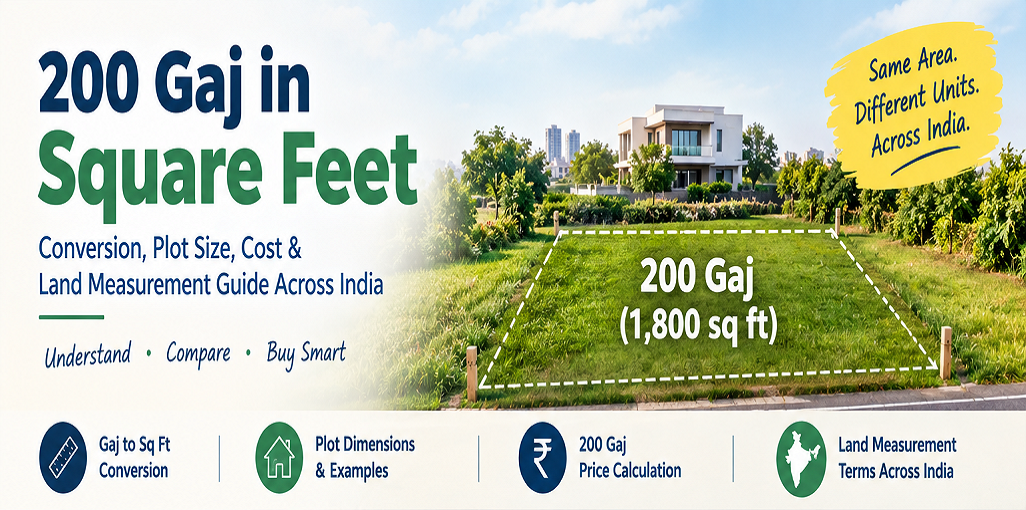
Last updated: Oct 01, 2026
When buying or selling residential plots, you may come across property sizes mentioned in gaj, square yards, or square feet. Among these, gaj is particularly common in property listings across several parts of North India. If you have come across a 200-gaj plot, you may want to know its equivalent area in square feet and square meters.
The standard conversion is straightforward: 1 gaj is equal to 9 square feet. Therefore, 200 gaj is equal to 1,800 square feet. Understanding this conversion can make it easier to compare plots, verify property details, and understand dimensions mentioned by developers, brokers, or property owners.
What Is Gaj in Land Measurement?
Gaj is a traditional unit of area measurement commonly used in Indian real estate. It is generally used to refer to a square yard when discussing land or property.
One gaj is equivalent to:
1 Gaj = 1 Square Yard = 9 Square Feet
Because of this relationship, converting gaj into square feet only requires multiplying the number of gaj by 9.
For example:
- 50 gaj = 450 sq. ft.
From Mughal Gaz to Modern Gaj
The linear "gaz" predates British involvement in India entirely; it was the Mughal empire's standard length measure, used for everything from land surveys to tailoring cloth, and its exact length varied somewhat by region and era before British administrators standardized it. Once the British formalized Indian weights and measures in the 19th century, the gaz was fixed at 3 feet (1 yard), and its square form, the gaj, used in land records became exactly 9 square feet, a value that has stayed constant ever since.
This history is part of why gaj survived so cleanly into modern property listings while bigha and katha didn't: unlike those units, which were tied to specific local agricultural traditions, gaj was always meant to be a standardized measure understood the same way across the empire. That standardization is exactly what makes it reliable for today's buyers.
How Many Square Feet Are There in 200 Gaj?
To calculate the area of 200 gaj in square feet, use the standard formula:
Square Feet = Gaj × 9
Therefore:
200 × 9 = 1,800 square feet
So, 200 gaj = 1,800 sq. ft.
This means a property described as a 200-gaj plot has an area of approximately 1,800 square feet when the standard square-yard convention is being used.
Common Gaj to Square Feet Conversions
| Plot Area in Gaj | Equivalent Area in Sq. Ft. |
| 20 Gaj | 225 Sq. Ft. |
| 50 Gaj | 450 Sq. Ft. |
| 75 Gaj | 675 Sq. Ft. |
| 100 Gaj | 900 Sq. Ft. |
| 125 Gaj | 1,125 Sq. Ft. |
| 150 Gaj | 1,350 Sq. Ft. |
| 200 Gaj | 1,800 Sq. Ft. |
| 250 Gaj | 2,250 Sq. Ft. |
| 300 Gaj | 2,700 Sq. Ft. |
| 500 Gaj | 4,500 Sq. Ft. |
The primary difference is the unit used to express the area.
A gaj generally refers to a square yard, while square feet is another unit used to measure area.
The standard relationship is
1 Gaj = 9 Square Feet
Therefore:
200 Gaj = 1,800 Square Feet
Knowing this relationship makes it easier to compare property listings that use different units.
What Is the Size of a 200 Gaj Plot?
A 200-gaj plot has a total area of 1,800 square feet. However, the dimensions of the plot do not have to be the same in every property.
For example, a 1,800-square-foot plot could have dimensions such as:
- 20 ft × 90 ft = 1,800 sq ft
- 30 ft × 60 ft = 1,800 sq ft
- 40 ft × 45 ft = 1,800 sq ft
- 36 ft × 50 ft = 1,800 sq ft
These are examples of possible dimensions. The actual dimensions depend on the shape and layout of the property.
This distinction is important because plot area and plot dimensions are not the same thing. Two properties can both measure 200 gaj but have different frontage and depth.
For someone planning to construct a house, the dimensions of the plot can be just as important as the total area.
What Can You Build on a 200 Gaj Plot?
A 200-gaj plot, or 1,800 sq ft, can be used for various residential purposes. Depending on the location and applicable regulations, it may be suitable for an independent house, builder floor, duplex-style residence, or other residential development.
However, the total plot area does not automatically determine how much construction can be carried out.
The permissible construction depends on factors such as:
- Local development authority regulations
- Floor Area Ratio (FAR)
- Setback requirements
- Ground coverage
- Road width
- Plot dimensions
- Building height regulations
- Land-use classification
- Parking requirements
- Local building approval rules
For example, a buyer may own a 200-gaj plot but may not be permitted to construct over the entire 1,800 sq ft footprint.
Therefore, buyers should check the applicable rules with the relevant local authority before making construction plans.
200 Gaj Property Price Calculation
The price of a property can be quoted either per gaj or per square foot, depending on the location and type of property.
For example, suppose a plot is priced at ?40,000 per gaj.
The approximate land value would be
200 × ?40,000 = ?80 lakh
Now consider the same property quoted at ?4,500 per square foot.
Since 200 gaj equals 1,800 sq ft:
1,800 × ?4,500 = ?81 lakh
These examples are only for understanding the calculation. Actual property prices can vary substantially based on location, road connectivity, infrastructure, zoning, market demand, property title, development status, and other factors.
How Gaj Is Used Across India
Property measurement practices can differ from one region to another. The term "gaj" is especially common in several North Indian property markets, including areas where residential plots and independent houses are frequently marketed using "gaj."
In other parts of India, buyers may more commonly encounter units such as
- Square feet – widely used across India
- Square meter – commonly used in official and planning contexts
- Cent—commonly encountered in parts of South India
- Guntha—used in parts of Maharashtra, Karnataka, and other regions
- Katha—used in several eastern and northern states, although its size can vary
- Bigha—used in many parts of North, West, and East India, with state- and region-specific variations
- Decimal—commonly encountered in parts of eastern India
- Acre – widely used for larger land parcels
Because regional land-measurement systems can vary, buyers should not assume that a local unit has exactly the same value everywhere.
For example, bigha does not have one uniform size throughout India. Its equivalent area can differ by state and sometimes even by district.
This is why standard units such as square feet, square yards, and square meters are useful when comparing properties across different cities and states.
Why Buyers Should Check the Measurement Unit
Suppose a property advertisement says that a plot is “200” without clearly mentioning the unit.
The number alone is not enough to understand the property size.
“200” could potentially refer to:
- 200 sq ft
- 200 sq yd
- 200 gaj
- 200 sq m
- Or another local measurement
The difference between these areas can be substantial.
For this reason, property buyers should always check the exact measurement unit mentioned in the sale documents, approved layout, property records, and agreement rather than relying only on a verbal description.
Important Points When Buying a 200 Gaj Property
Area is only one factor to consider when purchasing land. A buyer should also verify the property's legal and physical details.
Before purchasing a 200-gaj plot, consider checking:
1. Property Documents
Verify the ownership documents and title history of the property.
2. Approved Layout
Check whether the plot is part of an approved layout or development.
3. Actual Plot Dimensions
Confirm the length, width, and total area instead of relying only on the advertised size.
4. Land Use
Make sure the property is permitted for the intended residential or commercial use.
5. Access and Road Width
Road access can affect both usability and development potential.
6. Local Building Regulations
Check FAR, setbacks, ground coverage, parking, and other applicable rules.
7. Property Price
Compare the quoted rate with comparable properties in the same locality, while considering differences in location, road access, property condition, and other factors.
Frequently Asked Questions
1. How many square feet are in 200 Gaj?
200 gaj is equal to 1,800 square feet, based on the standard conversion of 1 gaj = 9 square feet.
2. Is 200 Gaj equal to 200 square yards?
Yes. In the standard usage of gaj as a unit of area, 200 gaj equals 200 square yards.
3. What is 200 Gaj in square meters?
200 gaj is approximately 167.23 square meters.
4. What is the formula for converting Gaj to square feet?
Multiply the area in gaj by 9.
Gaj × 9 = Square Feet
For example:
200 × 9 = 1,800 sq ft
5. Can a 200 Gaj plot have different dimensions?
Yes. A 200-gaj plot always has an area of 1,800 sq ft under the standard conversion, but its length and width can differ.
6. Is Gaj used throughout India?
Gaj is commonly used in property transactions in several parts of India, but different regions also use other local measurement units. The meaning of some traditional land units can vary by state or locality.
7. Is 200 Gaj a good plot size for a house?
A 200-gaj plot provides 1,800 sq ft of land area, but whether it is suitable for a particular house depends on plot dimensions, local building regulations, setbacks, FAR, parking requirements, and the buyer's requirements.
8. How much is 100 Gaj in square feet?
100 Gaj = 900 square feet.
9. How much is 300 Gaj in square feet?
300 Gaj = 2,700 square feet.
Conclusion
Understanding land and property measurements can make real estate transactions much easier. If a property is described as 200 Gaj, the standard conversion gives an area of 1,800 square feet or 200 square yards.
The basic formula is
1 Gaj = 9 Square Feet
Therefore:
200 Gaj × 9 = 1,800 Square Feet
For property buyers across India, however, it is important to remember that traditional land-measurement terms can vary from one region to another. Terms such as "bigha," "katha," "guntha," "cent," and "decimal" may have different local equivalents. For accurate comparison, buyers should use standard units such as square feet or square meters and verify the measurement from the property's official documents.
Content Editorial, Addressofchoice.com · Published July 8, 2025 · Last Updated Oct 01, 2026




Addressofchoice
https://www.addressofchoice.com/Address Of Choice is an online real estate consulting firm, who workes in across India. AOC deals in residential and commercial properties.
Get in Touch With us
Register here and Avail the Best Offers!!