
Cent to Square Feet: The South India Land Buyer's Guide (2026)
Aadil Saif 07 July 2025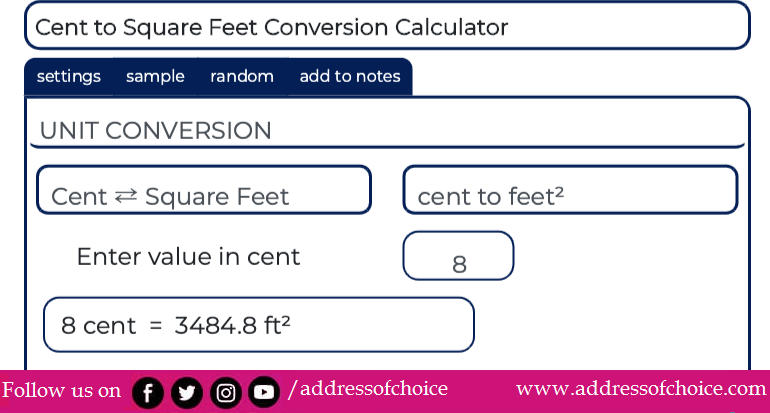
Last updated: July 10, 2026
If you've ever compared a plot listing in Kochi against one in Chennai, you've probably noticed both quote the price "per cent." That's not a coincidence — cent is the default land unit across Kerala, Tamil Nadu, and much of Karnataka and Andhra Pradesh, and unlike bigha or katha up north, its value never changes from district to district.
This guide covers the conversion formula, what a cent looks like next to other South Indian units like ground and guntha, where the name actually comes from, and how to check your cent figure against Kerala's Patta or Tamil Nadu's Chitta record before you buy.
Key Takeaways
- 1 Cent = 435.6 sq ft = 1/100th of an Acre — identical in Kerala, Tamil Nadu, Karnataka, and Andhra Pradesh.
- Cent is numerically the same unit as dismil, just under a different regional name.
- Always cross-check a quoted cent figure against your Patta (Tamil Nadu) or land tax receipt (Kerala) before finalising a purchase.
What Is a Cent in Land Measurement?
A cent is a unit of land area equal to 435.6 square feet, or exactly 1/100th of an acre. It's the standard unit for residential plots and small agricultural holdings across Kerala, Tamil Nadu, and parts of Karnataka and Andhra Pradesh, appearing directly in revenue records, sale deeds, and property listings throughout the region.
Cent is numerically identical to dismil, the unit used in Bihar, Jharkhand, Odisha, and West Bengal — both trace back to the same British-era logic of dividing an acre into 100 equal decimal parts, just adopted under different regional names during colonial land settlements. If you're comparing a cent-priced plot in the south against a dismil-priced one in the east, you can treat the two figures as directly equivalent without any adjustment.
Why "Cent" Became the Name in South India
The unit's name is a straightforward borrowing from "percent" — a cent of land is literally one-hundredth part of an acre, the same decimal logic that produced "dismil" further north and east. What's interesting is that South India's revenue administration under British rule was organised somewhat differently from Bengal's, which is part of why the same underlying decimal-fraction idea picked up a different regional name here rather than the "dismil/decimal" terminology used in Bihar and Bengal. Both terms describe the exact same mathematical concept; only the vocabulary differs by region.
Cent to Square Feet: Formula and Worked Examples
Square feet = Number of cents × 435.6
Cents = Square feet ÷ 435.6
<abc>
| Cents | Square Feet |
|---|---|
| 1 | 435.6 |
| 3 | 1,306.8 |
| 5 | 2,178.0 |
| 10 | 4,356.0 |
| 12 | 5,227.2 |
| 20 | 8,712.0 |
| 50 | 21,780.0 |
| 100 (= 1 Acre) | 43,560.0 |
How Cent Compares to Other South Indian Units
Cent isn't the only traditional unit you'll run into across the south. Chennai's residential market in particular runs on "ground" for house plots, which is considerably larger than a cent:
Guntha shows up in parts of Karnataka and Andhra Pradesh alongside cent, particularly for agricultural land — 1 guntha equals 1,089 square feet, or roughly 2.5 cents. If a deed near the Karnataka border mixes guntha and cent in the same document, convert both to square feet first before comparing. Our dedicated guntha to square feet guide covers that unit's own state-specific documentation in more depth.
Verifying Your Cent Figure: Kerala and Tamil Nadu Records
In Tamil Nadu, land ownership and classification are split across two linked documents: Patta, which records who owns the land, and Chitta, which records its revenue classification as agricultural or non-agricultural. Since 2015, both have been merged into a single digital Patta Chitta record, viewable through the state's official e-Services portal by entering the district, taluk, village, and survey number. Urban plots in cities like Chennai and Coimbatore instead use a Town Survey Land Register (TSLR) extract rather than a rural Patta.
Kerala's land records sit with the state's Revenue Department, which maintains ownership and tax details at the village (village office) level. Before finalising any cent-based purchase in Kerala, request the current land tax receipt and thandaper (account) number, and confirm the cent figure matches what's on file — a mismatch here is the single most common issue that delays registration.
In Karnataka, the equivalent verification runs through the RTC (Record of Rights, Tenancy and Crops) document, the same one used for guntha-based agricultural land, and increasingly accessible through the state's Bhoomi digital land records system. Whichever state you're in, the same principle from our guide to checking property and land records in India applies: verify before you negotiate, not after.
Cent Usage in Karnataka and Andhra Pradesh
Cent shows up less consistently in Karnataka and Andhra Pradesh than in Kerala or Tamil Nadu, mostly appearing in the border districts closest to those two states — parts of Kolar, Chikkaballapur, and the Bengaluru rural belt in Karnataka, and Chittoor and Anantapur in Andhra Pradesh, where cross-border property transactions have kept the terminology in circulation. Move further into either state's interior and guntha becomes the dominant unit for the same kind of agricultural or semi-urban plot instead.
This matters practically if you're comparing listings across a state border: a broker in Kolar might quote a plot in cents out of habit even though the underlying land record uses guntha, or vice versa. Since both units convert cleanly to square feet — cent at 435.6 sq ft, guntha at 1,089 sq ft — the safest approach is always to ask which unit the actual RTC or Patta document uses, then convert that figure yourself rather than assuming the broker's spoken unit matches the paperwork.
Cent and Your Home Loan
As with any traditional land unit, a cent figure only carries weight with a lender once it's backed by the official record. Banks financing a cent-priced plot in Kerala or Tamil Nadu will typically commission their own valuation against the Patta, Chitta, or thandaper entry rather than accepting a seller's quoted figure directly, and the loan-to-value ratio they offer is calculated against that verified area. If the cent figure a broker quotes doesn't match what the official record shows once converted to square feet, resolve that gap before you apply for financing — it's easier to renegotiate the price than to discover a shortfall in your sanctioned loan amount midway through the purchase process.
Common Mistakes Buyers Make With Cent-Measured Land
- Assuming "cent" and "ground" are interchangeable. They're not — a ground is 2,400 sq ft, more than five times a single cent.
- Not distinguishing Patta from Chitta in Tamil Nadu. Ownership and revenue classification are two separate checks; both matter before you sign anything.
- Skipping the Kerala thandaper cross-check. A seller's quoted cent figure should match the number on the current tax receipt, not just an old sale deed.
- Converting guntha to cent using rough estimates. Use the exact 1,089 sq ft value for guntha rather than rounding, especially on larger agricultural parcels.
- Ignoring survey subdivisions. A single survey number can cover multiple sub-divided plots — confirm you're looking at the specific sub-division being sold.
- Not reconciling the cent figure with the lender's independent valuation. As covered above, a gap here can affect your approved loan amount, not just your negotiating position.
- Overlooking TSLR requirements for urban Tamil Nadu plots. A rural-style Patta check isn't sufficient inside city survey limits — ask specifically for the Town Survey Land Register extract.
- Assuming a broker's spoken unit matches the underlying record. Near the Karnataka and Andhra Pradesh borders especially, a plot quoted in cents may actually be recorded in guntha on the RTC — always confirm the unit on the document itself, not just what's said out loud.
Quick Reference: Cent Conversion Table
| Unit | Value |
|---|---|
| 1 Cent | 435.6 sq ft = 48.4 sq yd = 40.46 sq m |
| 1 Acre | 100 Cents |
| 1 Cent | 1 Dismil (numerically identical) |
| 1 Ground (Chennai) | 2,400 sq ft ≈ 5.51 Cents |
| 1 Guntha | 1,089 sq ft ≈ 2.5 Cents |
Frequently Asked Questions
How many cents make one acre?
Exactly 100 cents make one acre. Since 1 acre equals 43,560 square feet and 1 cent equals 435.6 square feet, dividing confirms the fixed 100:1 ratio, consistent across Kerala, Tamil Nadu, Karnataka, and Andhra Pradesh.
Is a cent the same as a ground in Chennai?
No. A ground is a separate, larger unit used specifically for Chennai's residential plots, equal to 2,400 square feet — more than five times the size of a single cent. Always confirm which unit a Chennai listing is actually using before comparing prices.
Is cent the same as dismil?
Yes. Cent and dismil are numerically identical, both equal to 435.6 square feet. Cent is the term used in Kerala, Tamil Nadu, Karnataka, and Andhra Pradesh, while dismil (or decimal) is used in Bihar, Jharkhand, Odisha, and West Bengal.
How do I verify a cent figure on a Tamil Nadu property?
Check the Patta Chitta record through Tamil Nadu's official e-Services portal using the district, taluk, village, and survey number. For urban plots in cities like Chennai, request the TSLR extract instead, which covers Town Survey Land Register entries.
What should I check before buying cent-measured land in Kerala?
Request the current land tax receipt and thandaper account number from the seller, and confirm the cent figure listed matches the village office's record. A mismatch between the sale deed and the current tax record is the most common cause of registration delays in Kerala.
Does the cent figure affect my home loan approval?
Yes, indirectly. Lenders base loan-to-value calculations on their own valuer's confirmation against the Patta, Chitta, or thandaper record, not a seller's quoted cent figure. Reconciling any gap before you apply for financing avoids a lower-than-expected sanctioned amount.
Is cent used in Karnataka and Andhra Pradesh too?
Cent appears mainly in the districts of Karnataka and Andhra Pradesh that border Kerala and Tamil Nadu, such as Kolar and Chittoor. Elsewhere in both states, guntha is the more commonly used unit for similar agricultural and semi-urban plots, so it's worth checking which unit the actual land record uses rather than assuming based on the region.
The Bottom Line
Cent is one of the more buyer-friendly units in Indian real estate precisely because it never changes value by district — 435.6 sq ft, whether you're in Thiruvananthapuram or Coimbatore. The real work is confirming that the cent figure quoted to you matches what Kerala's village office or Tamil Nadu's Patta Chitta record actually shows, since that's where discrepancies tend to surface — and where your lender will look first if financing is involved.
For the eastern-India equivalent of this same unit, see our guide to dismil to square feet conversion, and if you're comparing cent-priced land against square-foot-priced apartments, you can browse verified listings on AddressOfChoice to compare pricing directly.
Content Editorial Team, Addressofchoice.com · Published July 10, 2026 · Last Updated July 10, 2026




Aadil Saif
https://www.addressofchoice.com/I am Adil Saif working with AddressOfChoice Realty Private Limited as a Digital Marketing Expert. I have 8 Year Experience in same field. I love to share blog and Article.
Get in Touch With us
Register here and Avail the Best Offers!!